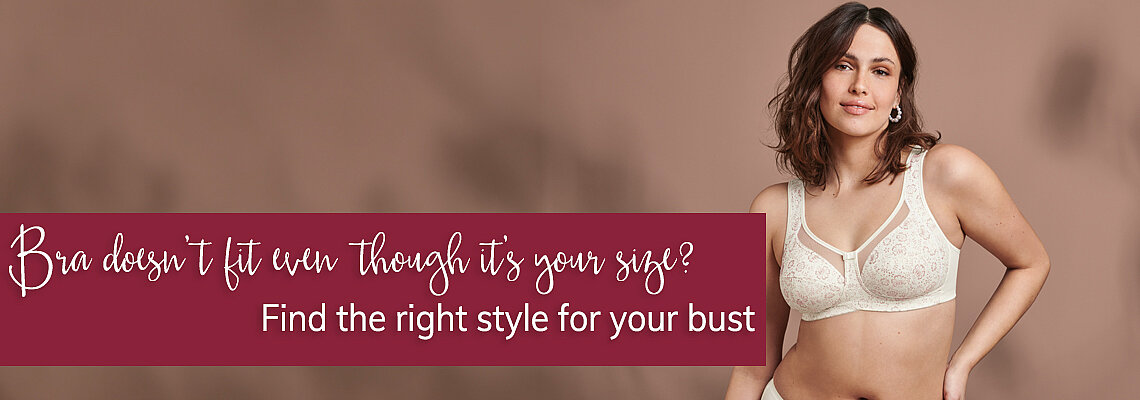
Bra doesn't fit despite the right size? Here's how to find the right cut for your breast shape.
Many women know the problem: You have determined your bra size, the bra fits "correctly" according to the measuring tape - and yet it doesn't feel good. It presses, cuts in, stands away, or doesn't shape the breast the way you want it to. Especially in everyday life, when you wear your bra for many hours, this quickly becomes a burden.
This can be frustrating - especially if you actually assume you've done everything right. But the good news is: In many cases, the problem is not the size at all.
The crucial factor is often underestimated: your breast shape.
Because even with identical bra sizes, breasts can differ greatly. These very differences determine which cut really suits you - and whether your bra feels comfortable or not.
Why Your Bra Doesn't Fit Despite the Right Size
The bra size is only part of the fit. It describes the ratio of underbust width and cup, but says nothing about how your breast is shaped or how the tissue behaves.
This means: Two women with the same size can have completely different requirements for their bra.
If the cut doesn't match your breast shape, typical problems appear in everyday life:
- The bra cuts in or presses at certain points
- The cups stand away or wrinkle
- The breast is unnaturally shaped or not sufficiently supported
- The bra slips or feels unstable
- Straps cut in, even though the size is correct
It is often mistakenly assumed that the size is incorrect. In reality, the problem often lies with the cut.
A well-fitting bra must always combine two things: the right size and the appropriate cut for your individual breast shape.
What Role Your Breast Shape Really Plays
Breast shapes are as individual as women themselves. Nevertheless, typical shapes can be distinguished, which can help you better categorize your own breasts.
This categorization is not a rigid system, but an orientation – because many women fall between several shapes.
Full, round breast: The volume is evenly distributed, the breast appears evenly shaped.
Sloping breast: Less volume in the upper area, the breast appears flatter in the upper area.
Sagging breast: Softer connective tissue, often more volume in the lower area, the breast sits overall lower.
Small breast: Less volume and often finer tissue structure.
Large breast: More volume and weight, often with a higher need for support and relief.
Additionally, there are also asymmetrical or laterally oriented breast shapes. Slight differences are completely normal and must be considered when choosing a bra.
What is important: Your breast shape significantly influences how a bra fits, supports, and shapes. A model that works perfectly for another woman may feel completely different for you.
Which Bra Cut Fits Your Breast Shape
The choice of the right bra strongly depends on the shape of your breasts and the wearing comfort you desire. The cut determines whether the bra optimally supports your breasts or if fit issues arise.
Full, Round Breasts This breast shape is particularly versatile. Many bra models fit well and provide a beautiful silhouette. Depending on your outfit and personal preference, you can choose between different cuts – from classic underwire bras to wire-free options (discover suitable bras).
Sloping Breasts Here, it can be useful to create more volume in the upper area. Push-up bras, padded bras or molded cups can help balance the appearance of the breasts and support a more even shape. It is important that the cups fit well and do not stand away.
Sagging Breasts For this breast shape, models with good support and shaping power are particularly important. Less elastic materials, stable underbust bands, and shaping cups provide support and a defined silhouette. Whether with padding or underwire depends on your personal comfort preference.
Small Breasts If you desire more volume, padded bras or molded bras can be a good choice. They gently shape the breasts and provide a more even appearance under clothing. Light, flexible models can also be very comfortable for everyday wear.
Large Breasts Here, stability and relief are the focus. Underwire bras can provide a clear shape, while wire-free models are particularly convincing in everyday life due to their high wearing comfort. Wide straps, a stable underbust band, and a well-thought-out construction are crucial.
In general, the right bra cut supports your natural shape – it works with your body, not against it.
Typical Mistakes When Choosing a Bra
Even if the size is correct, small decisions can have a big impact on the fit. Many problems arise from recurring patterns in selection.
Typical mistakes are:
- You choose a bra based only on appearance and not on function
- The cut does not match your breast shape
- You stick with a model that fundamentally does not suit you
- The underband is too loose or too tight
- The straps take on too much weight
- You try too few alternatives
Especially when you have found a model once, you often stick with it – even if it is not optimal. A different cut can already make a big difference.
How to Find the Right Bra for You
The most important step is to get to know your own breast shape better and not just choose the bra based on size.
It is helpful to consciously compare different models and pay attention to how they feel in everyday life. A bra may seem good when you first try it on – but what matters is how it feels over several hours.
When trying on, pay particular attention to the following points:
- Does the underbust band sit stable and comfortable?
- Do the cups fully enclose your breast without cutting in or standing out?
- Do the straps sit comfortably without exerting pressure?
- Do you feel free and supported in your movement?
A well-fitting bra should accompany you in everyday life without you constantly having to think about it.
Tools like a bra finder can additionally help you find suitable models faster. They take into account both size and shape and give you targeted guidance.
Conclusion: The right cut makes the difference
If your bra doesn't fit despite the correct size, it's worth taking a closer look. In many cases, the solution is not in a different size – but in the right cut.
Your breast shape plays a central role in fit, comfort, and support. If you take it into account, you can make more targeted choices and avoid bad purchases.
A well-chosen bra supports you, adapts to your body, and ensures that you feel comfortable all day long.
Frequently Asked Questions About Bra Fit
Is my bra wrong if it doesn't fit despite being the right size?
Not necessarily. Often, it's not the size but the cut that doesn't suit your breast shape.
How can I tell if the bra cut doesn't fit?
Typical signs are cutting wires, gaping cups, wrinkling, or an uncomfortable feeling in everyday wear.
Is breast shape really that crucial for a bra?
Yes. The breast shape affects how a bra sits, supports, and shapes. That's why different models can fit better or worse even in the same size.
How do I find the right bra for my breast shape?
By trying different cuts and paying attention to how the bra feels throughout the day. Tools like a bra finder can also provide guidance.

Comments:
No Comments
